
Taking a door off its hinges sounds straightforward, but once the door is made of glass, the situation changes completely. A timber door can often be lifted or unpinned with basic tools. A shower door cannot. It is heavier, more fragile, and usually fixed with clamp-style hinges rather than removable pins.
That is why the first thing to understand is not how to remove the door, but what kind of hinge is holding it in place. In many bathroom setups, the door is supported by fixed-position shower door hinges designed to hold weight and keep alignment stable during daily use. Removing the door is less about pulling it free and more about releasing it safely.
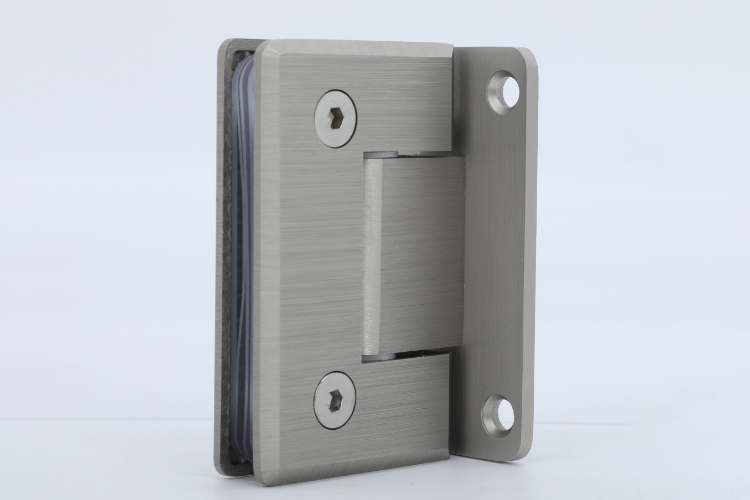
Most people expect hinges to work the same way, but glass shower hinges are built differently. There is no loose pin to tap out. Instead, the hinge clamps the glass panel and is fixed to the wall or another glass surface.
This design keeps the door stable, but it also means removal has to be controlled. Trying to lift the door without loosening the hinge properly will not work and may damage the glass edge.
In real installation work, the hinge is part of the structure, not just a connector. That is why it should always be treated as a load-bearing component rather than a simple fitting.
Before loosening anything, the door must be supported. This is the step that gets skipped most often, and it is also where problems begin.
A glass shower door carries noticeable weight. Even if it does not feel heavy at first, once one hinge is loosened, the remaining hinge takes all the stress. Without support, the glass can shift suddenly.
In practice, installers usually work with two people. One holds the door steady, while the other loosens the hinge screws gradually. Some projects also use temporary support blocks or soft padding at the bottom to reduce movement.
This step is not about speed. It is about control.
Once the door is supported, the hinges can be loosened. The key here is balance.
Do not fully remove one hinge while the other is still tight. That creates uneven pressure and can twist the glass. Instead, loosen both hinges step by step, reducing tension evenly.
This approach keeps the door stable during removal and avoids sudden shifts. It also makes it easier to guide the panel away from the wall once the connection is fully released.
In real-world projects, this is where experience shows. The difference between a smooth removal and a cracked edge often comes down to how evenly the load is released.
Not every door comes off the same way. The thickness of the glass, the width of the panel, and the condition of the wall all affect how the removal should be handled.
Most shower doors use tempered glass in the range of 8–12 mm, which gives strength but also requires careful handling. The hinge system is designed to match this thickness and support the weight safely.
Wall condition also matters. If the fixing points are not stable, the hinge may not release evenly. This is especially important in renovation work, where previous installations may have shifted over time.
Sometimes a door feels stuck or misaligned, and removal seems like the only solution. In reality, many issues can be solved without taking the door off completely.
Loose screws, slight alignment shifts, or wear inside the hinge can affect how the door opens. Checking these first can save time and reduce risk.
A well-made hinge is designed to keep smooth movement even with frequent use. If the structure is stable, small adjustments are often enough to restore normal operation.
In bathroom environments, moisture is constant. That is why hinge material matters not only for installation but also for long-term use.
Stainless steel, brass, and treated surfaces help reduce corrosion and keep the hinge working smoothly over time. A stable finish also makes it easier to handle the hardware during removal or reinstallation.
For projects that require consistent performance across multiple units, this becomes even more important. Hardware that holds up well in daily use is easier to service later.
For contractors and distributors, removing one door is not the real issue. The real concern is whether the same process will be repeated across many units.
If the hinge design is inconsistent or difficult to handle, maintenance becomes slower and more expensive. This is why many buyers focus on standardized specifications, stable structure, and repeatable installation logic.
A reliable hinge system should make both installation and removal predictable. That is where supplier capability matters, especially for OEM or project-based requirements where dimensions, finishes, or configurations may vary.
Taking a door off the hinges is simple for a standard door, but for a shower door, it requires a different approach. The key is to understand the hinge type, support the glass properly, and release the load gradually.
A glass door is not something to force or rush. It is a system that needs to be handled with control.
If you are working on bathroom projects and need reliable shower door hinges, we can help you review structure, material options, and OEM or ODM requirements. Share your project details with us, and we can help you choose hardware that is easier to install, easier to maintain, and more consistent in long-term use.
Previous: