In schools and hospitals, Door Hardware is not only selected for appearance. Children, elderly patients, visitors, nurses, cleaners, and maintenance teams all use the same doors in different ways. Some users move quickly. Some have limited hand control. Some push the door while holding books, medical supplies, bags, or mobility equipment. If the handle edge is too thin, the grip area is too tight, or the clearance around the door hardware is poorly planned, finger trapping can become a serious safety concern.
For contractors, school facility buyers, hospital project teams, architectural hardware distributors, and public building developers, flush door handles should be reviewed through safety, grip comfort, clearance, installation height, and long-term maintenance. A handle that looks neat on the door can still create risk if the user’s hand is guided into a pinch point.
Finger trapping often happens where the hand naturally moves: near the handle base, around the rosette, between the handle and door surface, or close to the door edge. If the clearance is too narrow, users may place their fingers where the hardware, door leaf, and frame create a squeezing point.
This is more risky in schools and hospitals because users may not operate the door slowly. Students may pull doors quickly between classes. Patients may lean on the handle for balance. Staff may open doors while pushing equipment. Hardware should guide the hand into a safe grip area, not into a tight gap.
A handle may pass a basic size check but still feel uncomfortable during use. The grip should allow enough space for different hand sizes, including children, adults, and gloved staff. If the handle profile is too narrow or the grip area feels sharp, users may hold the edge instead of the intended contact zone.
For project buyers, this is where sample testing matters. The handle should be tested by actual users or facility teams before bulk installation, especially in classrooms, wards, washrooms, treatment rooms, and corridor doors.
Door hardware used in public buildings should avoid aggressive edges. Thin, sharp, or poorly finished edges can scrape skin, catch fingers, or create discomfort during frequent use. Smooth transitions around the handle body and rosette help users grip and release the handle more naturally.
Our stainless steel hollow special-shape door handle can be supplied in SS304 or SS316, with finishes such as SSS, PSS, PVD, SN, CP, AB, ACM, PB, SB, or customized options. For schools and hospitals, finish choice should support not only the interior style, but also daily cleaning and long-term touch comfort.
The rosette is often ignored during safety review. A handle may have a comfortable grip, but if the rosette sits too close to the hand path or creates a tight ledge, fingers can still be caught during fast operation.
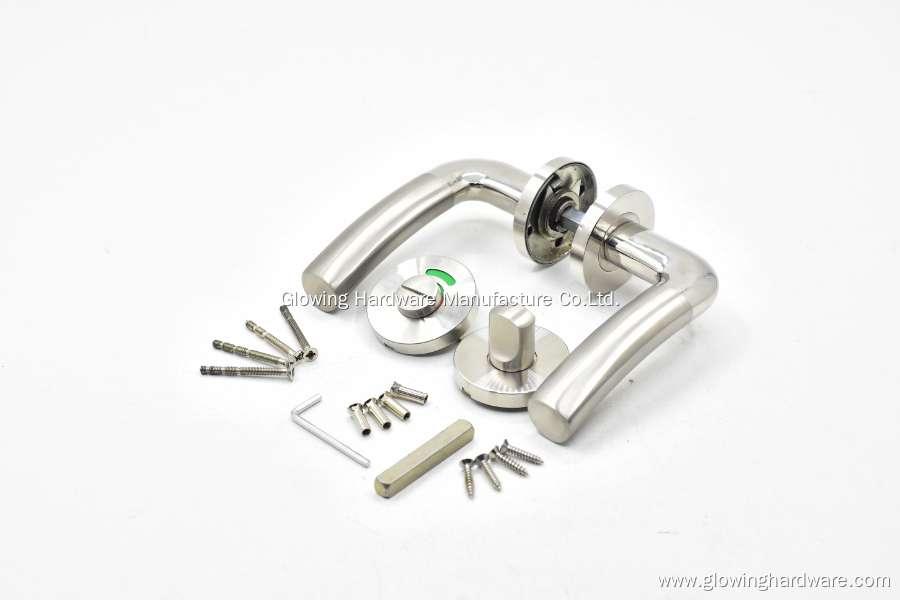
The K104 handle uses a φ53×9mm rosette direction. For project use, the rosette should be checked together with door thickness, lock body, handle return movement, and the space between the user’s hand and the door face. The goal is to keep the operation smooth and predictable.
School doors face a different usage pattern from private interiors. Students may pull handles with force, bump doors with bags, open washroom doors quickly, or use classroom doors many times during the day. If the handle has weak edges, unstable fixing, or uncomfortable grip, the safety risk becomes higher.
For school projects, the handle should be easy to recognize and easy to operate. Complicated forms may look unique, but the safer choice is usually a clear grip shape with stable mounting and enough hand clearance.
Washroom doors are common locations for hardware complaints. Wet hands, fast use, privacy locks, and frequent cleaning all place pressure on the handle set. The K104 door handle set includes the handle, thumb-turn, and indicator, and can be used with a washroom door functional Mortise Lock.
For school and hospital washroom areas, the thumb-turn and indicator should be checked for simple operation, strong construction, and clear user feedback. If a user struggles with the lock, they may grip the handle awkwardly and increase the chance of hand contact with unsafe areas.
Hospital staff may move through doors while carrying trays, supplies, documents, cleaning tools, or medical items. They need door hardware that is easy to operate without precise hand positioning. If the handle requires an awkward grip, it slows movement and increases the chance of accidental finger contact.
A public healthcare door handle should provide a stable grip and predictable operation. It should also allow cleaning teams to wipe the surface easily because hospital hardware is touched often throughout the day.
Patients and visitors may have weaker grip strength or slower reaction. If a handle feels hard to turn, too thin to hold, or confusing to use, it can create unnecessary stress. In patient rooms, washrooms, and corridor areas, hardware should feel simple and safe.
For flush door handles used or specified in healthcare interiors, buyers should check whether the handle profile, mounting height, clearance, and lock function match the people who will use the door every day.
A handle installed at the wrong height or too close to a door edge can create awkward operation. In public buildings, the installation team should follow the project’s door schedule and accessibility requirements. A good handle can still become uncomfortable if it is mounted without considering user movement.
Project buyers should confirm door type, door thickness, lock case, handle center distance, opening direction, and user group before production. This reduces on-site adjustment and helps avoid unsafe hand positions after installation.
Loose handles create more than maintenance trouble. When a handle shakes, users may grip harder or pull from the wrong angle. In busy schools and hospitals, loose fixing can quickly turn into complaints.
The handle should be installed with suitable hardware and checked after handover. For bulk projects, consistent fastener quality, clear installation guidance, and spare part planning can reduce later maintenance pressure.
Schools and hospitals require regular cleaning. Door handles may be wiped many times each day. If the surface finish wears too quickly, stains easily, or reacts poorly to cleaning agents, the hardware may look aged before the project should need replacement.
Buyers should select finishes with the cleaning routine in mind. A decorative finish that is difficult to maintain may not be suitable for high-touch doors in public buildings.
A handle that becomes loose, bent, scratched, or damaged after long use can create new pinch points. Maintenance teams should inspect public building handles regularly, especially around washrooms, classrooms, patient rooms, and corridor doors.
For distributors and contractors, after-sales planning should include replacement screws, matching accessories, and clear maintenance guidance. This helps facilities keep hardware safe after the initial installation.
A handle edge that is dented during transport may not sit correctly or may feel rough during use. For public projects, visible damage also creates handover problems. Hardware should arrive protected, organized, and ready for installation.
The handle can be packed in white or brown inner boxes with export cartons. For large project orders, packing should prevent surface rubbing, rosette damage, missing accessories, and mixed finish problems.
Schools and hospitals may order different finishes, lock functions, and door hardware types in one shipment. If cartons are not clearly marked, the installation team may fit the wrong handle in the wrong area.
Clear labeling by project zone, finish, model, and door type can reduce site confusion and speed up installation.
Finger trapping risk is easier to prevent before the door hardware is installed. Project buyers should review handle edge design, hand clearance, rosette shape, lock function, mounting height, door type, finish, packing, and maintenance needs before confirming bulk orders.
For schools, hospitals, clinics, care facilities, washrooms, and public interior projects, flush door handles should be chosen with real users in mind. The safest-looking hardware is not always the best choice. The better choice is the one that gives users a clear grip, enough clearance, smooth operation, and fewer hidden pinch points.
If your project needs Stainless Steel Door Handles for school, hospital, washroom, or public building use, come to us to prepare the hardware selection properly. Send the door type, lock function, finish requirement, user group, safety concern, packing method, and order quantity. Our team can help match door handle options that are easier to operate, safer to grip, and better suited for high-use public building projects.