Locksmiths do not usually recommend one lock for every door. A suitable lock for an apartment entrance may be unnecessary for an interior office, while a basic residential lock may not be appropriate for a hotel, school, hospital, or commercial storage room.
A professional recommendation normally begins with the door itself. The locksmith checks the door material, frame condition, opening direction, thickness, existing preparation, user traffic, required access control, and emergency-exit rules before selecting the lock.
The best lock is therefore the one that fits the complete opening and performs the required function reliably.
The first question is not how expensive the lock is. It is what the door needs to do.
A residential entrance normally needs controlled access from outside and convenient exit from inside.
A properly installed deadbolt is often used together with a latch or lever set. The frame, strike plate, fasteners, hinges, and door material should be checked at the same time.
Interior privacy doors usually need a simple locking function with an emergency-release feature.
A high-security entrance lock is unnecessary here and may create inconvenience during an emergency.
A commercial entrance may need a Mortise Lock, cylindrical lock, access-control system, electric strike, or panic hardware depending on traffic and local code.
The lock must work with the door closer, hinges, frame, and exit requirements.
Hotels and managed apartments may require mechanical master-key systems, card access, keypad locks, mobile credentials, or a combination of electronic and mechanical backup.
The project team should also consider audit records, battery management, spare parts, and administrator control.
A lock should not be judged only by weight, appearance, or advertising language.
Recognized performance standards may evaluate areas such as:
Operational cycles
Strength
Security
Durability
Finish resistance
Latch operation
Cylinder performance
Dimensional consistency
ANSI/BHMA product grades commonly range from Grade 1 to Grade 3, with Grade 1 representing the highest performance level within the relevant standard.
The required grade depends on the application. A high-traffic commercial door may need stronger cycle performance than a lightly used residential storage door.
A spring latch holds the door closed and is retracted by the handle.
A deadbolt is moved into the frame by a key, thumb turn, or controlled mechanism. It does not rely on a spring to remain extended.
For suitable exterior doors, a deadbolt can add resistance beyond a standard spring latch.
However, the deadbolt only performs properly when:
It extends fully
The strike is aligned
The frame is strong
The door does not flex excessively
The cylinder matches the door thickness
Installation follows the product instructions
A strong lock attached to damaged timber or a loose frame does not create a strong door system.
A mortise lock is installed inside a pocket prepared in the edge of the door.
The lock case may combine the latch, deadbolt, cylinder, handle operation, and other functions in one system.
A High Security Mortise Lock may be considered for hotels, offices, public buildings, premium residential doors, and high-use commercial openings.
A well-designed mortise system can provide:
Multiple lock functions
Strong internal construction
Compatibility with lever handles
Different cylinder options
Replaceable internal components
Coordinated latch and deadbolt operation
Project-specific access functions
Correct door preparation is essential because the lock case must fit accurately inside the door.
The visible key cylinder is only one part of the locking system.
Locksmiths may review:
Cylinder profile
Key control
Duplicate-key management
Drill resistance
Pick resistance
Master-key compatibility
Emergency access
Thumb-turn requirements
Cylinder projection
Replacement availability
A high-security cylinder should not project excessively beyond the escutcheon or protective trim.
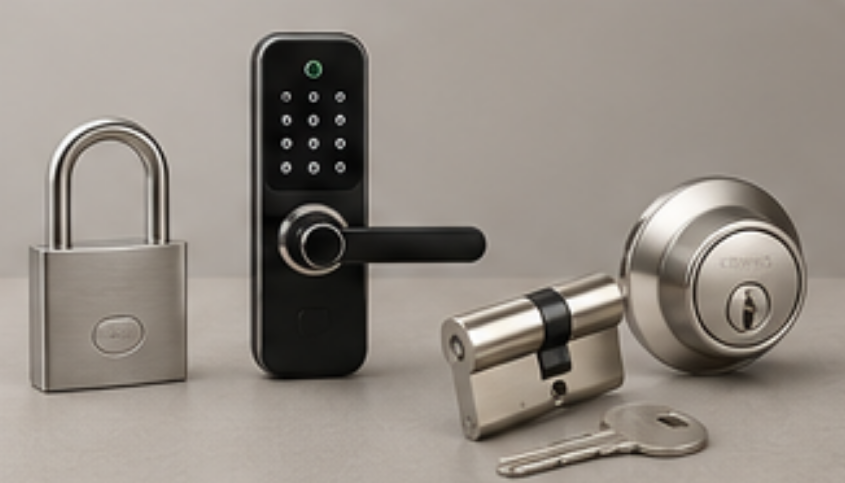
Smart locks can be suitable when the buyer needs keyless entry, temporary codes, access records, fingerprint operation, mobile control, or remote user management.
They are not automatically more secure than every mechanical lock.
A smart lock still depends on:
Mechanical lock body
Door and frame strength
Battery condition
Administrator settings
Credential management
Software support
Emergency power
Mechanical backup
Correct installation
The electronic features should solve a real access-management need rather than being selected only for appearance.
Security should not make it difficult for occupants to leave during an emergency.
Double-cylinder locks and other key-required interior operations may be restricted in some locations because occupants must be able to exit quickly.
Commercial and public doors may also need specific fire, accessibility, or egress hardware.
Always confirm local requirements before ordering a lock for a fire-rated or emergency-exit door.
A professional may recommend repairing the door before replacing the lock.
Typical problems include:
Loose hinges
Misaligned strike plate
Split frame
Excessive door gap
Weak mounting screws
Warped door leaf
Damaged closer
Incorrect lock backset
Loose handle spindle
Corroded internal parts
Replacing only the cylinder will not correct these structural issues.
Our product range includes mortise locks, Smart Door Locks, Door Cylinders, latches, lever handles, hinges, door bolts, guards, chains, viewers, and related architectural hardware.
Our factory was established in 1993 and supports OEM and ODM projects for door manufacturers, hotels, public buildings, property developments, supermarkets, and hardware distributors.
Production equipment includes CNC-controlled lathes, digital milling machines, spark-erosion equipment, forming machinery, pipe-bending machines, and welding systems.
Send us the door material, thickness, backset, lock-case dimensions, required function, cylinder type, handle design, finish, testing requirement, packaging, and order quantity.
We will review the complete opening and prepare a High Security Mortise Lock proposal suitable for your project.