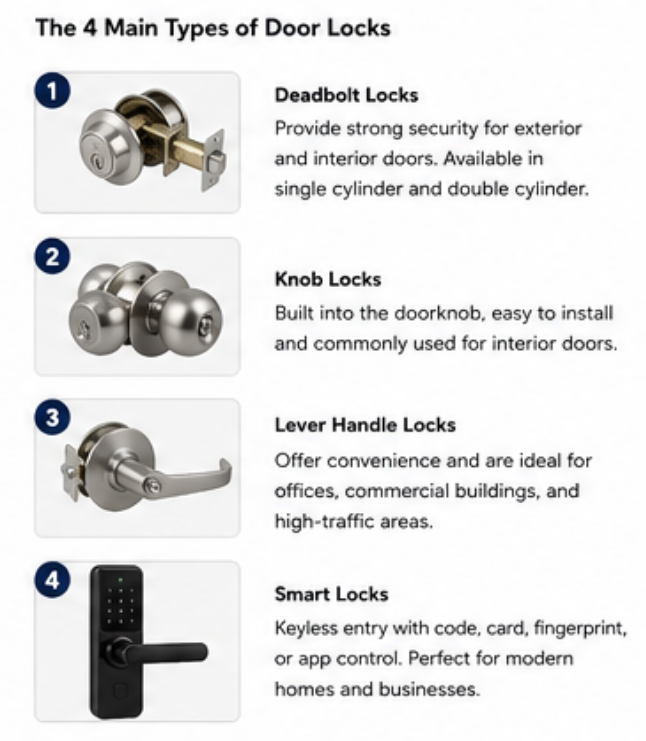
Door locks can be grouped in several ways. They may be classified by installation method, locking mechanism, access method, or intended function.
For practical purchasing, four common categories are:
Cylindrical locks
Deadbolts
Smart or electronic locks
These categories are not always completely separate. A smart lock may operate a deadbolt, and a mortise lock may use an electronic reader.
A cylindrical lock is installed through round openings prepared in the face and edge of the door.
The outside and inside handles connect through the door, while a separate latch enters the door edge.
Cylindrical locks are common in:
Residential rooms
Offices
Hotel service areas
Classrooms
Storage rooms
Light commercial interiors
They can be supplied in passage, privacy, entrance, storeroom, classroom, and other functions.
Cylindrical locks are generally easier to install than full mortise systems.
They also allow damaged handle sets or latches to be replaced without removing a large lock case from inside the door.
Important specifications include:
Door thickness
Backset
Bore diameter
Latch length
Handle function
Handing
Strike plate
Finish
Required performance grade
A lock that fits the face opening may still be incompatible with the latch preparation or door thickness.
A mortise lock uses a rectangular lock case installed inside a prepared pocket in the door edge.
The case may contain the latch, deadbolt, follower, springs, and other internal components.
Mortise locks are frequently used in:
Hotels
Apartments
Offices
Hospitals
Schools
Public buildings
Premium residential doors
High-traffic commercial entrances
They are suitable when the project needs several lock functions within one coordinated system.
A complete mortise installation may include:
Lock body
Lever handles
Cylinder
Thumb turn
Escutcheons
Strike plate
Spindle
Fixing screws
Door-edge faceplate
Accurate dimensions are critical because the lock body must align with the handle, cylinder, and strike.
A deadbolt uses a solid bolt that moves into the door frame.
Unlike a spring latch, the bolt does not retract simply by pushing against its angled surface.
A single-cylinder deadbolt uses a key on the exterior side and a thumb turn on the interior side.
This structure supports convenient exit without searching for a key.
A double-cylinder model uses a key on both sides.
Although it may be considered where glass is close to the lock, it can create emergency-exit concerns and may be restricted by local codes.
The bolt should extend fully into a suitable strike or reinforced box.
The door frame and fixing screws must be strong enough to support the locking point.
A smart lock uses electronic credentials instead of, or in addition to, a traditional key.
Access methods may include:
PIN code
Fingerprint
Card
Mobile application
Bluetooth
Wi-Fi
Face recognition
Temporary digital credential
Mechanical backup key
Smart locks are practical for:
Hotels
Serviced apartments
Offices
Rental properties
Shared spaces
Managed residences
Restricted rooms
They allow access rights to be changed without distributing new mechanical keys to every user.
A smart lock requires a plan for:
Battery replacement
User enrollment
Administrator accounts
Lost phones or cards
Temporary access
Network availability
Audit records
Software updates
Emergency power
Mechanical override
Technology improves convenience only when the access process is managed correctly.
| Lock Type | Installation | Main Strength | Typical Use |
|---|---|---|---|
| Cylindrical lock | Round bores through door | Simple installation and common functions | Residential and light commercial |
| Mortise lock | Lock case inside door edge | Multiple functions and robust structure | Hotels and commercial projects |
| Deadbolt | Separate or integrated bolt | Additional exterior-door locking point | Residential and entrance doors |
| Smart lock | Mechanical lock with electronic access | Keyless control and user management | Hotels, rentals and offices |
The correct option depends on the door and required function rather than the product category alone.
The four categories above do not cover every product.
Additional systems include:
Rim locks
Multipoint locks
Sliding-door locks
Electromagnetic locks
Electric strikes
Panic exit devices
Glass-door locks
Cabinet locks
Padlocks
Auxiliary bolts
Large projects may use several lock types in the same building.
A Complete Door Lock System should coordinate the lock body with the cylinder, handle, hinges, strike, door closer, frame, and access-control requirements.
Before placing an order, provide a door schedule that includes:
Door number
Door material
Door thickness
Opening direction
Lock function
Fire rating
Access method
Handle type
Finish
Quantity
This reduces mismatched parts during installation.
We manufacture mechanical and smart locks together with cylinders, latches, stainless steel handles, hinges, bolts, door guards, Door Viewers, and other accessories.
OEM and ODM services support custom dimensions, materials, functions, finishes, logos, packaging, and matching hardware sets.
Our production system covers original product development, machining, forming, welding, assembly, inspection, packaging, and international shipment.
Send us your door schedule, drawings, lock functions, access requirements, dimensions, materials, finish references, testing standards, packaging, and project quantity.
We will prepare a coordinated Complete Door Lock System proposal for your building or distribution market.