Online posts sometimes suggest placing a rubber band around a doorknob when someone is home alone.
The reason given may be to create a reminder, improve grip, make the handle harder to turn, or produce a small sound when the door moves.
A rubber band may have a harmless household use, but it should not be treated as a dependable door-security device.
It cannot replace a working lock, reinforced strike, door guard, viewer, or properly installed access-control system.
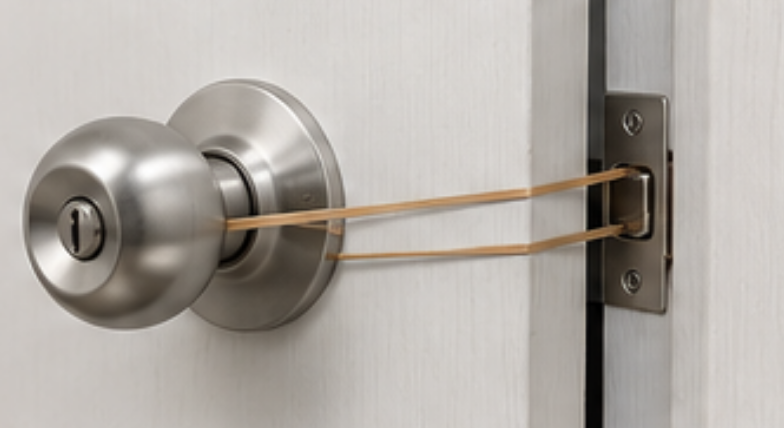
Some people use a brightly colored band to remind themselves that the door should be checked before sleeping or leaving the room.
This is similar to placing a note near the handle.
The band does not strengthen the lock. It only acts as a visual cue.
A rubber band may provide temporary grip on a smooth round knob.
This can help someone open a non-locking interior door, but it should not be wrapped so tightly that it interferes with the latch or emergency operation.
A proper lever handle or approved grip accessory is safer for long-term accessibility.
A loose band attached to a harmless object may make a small sound when the door moves.
This can indicate that the door has been opened, but it is not an alarm system and should never be relied on for personal safety.
Some people loop a band around both handles to keep an interior latch retracted.
This may be useful temporarily when carrying items through a non-fire-rated interior door.
It should not be used on fire doors, security doors, exterior entrances, hotel doors, or any opening that needs to latch correctly.
Rubber stretches, breaks, slips, and loses tension.
It provides no tested resistance against impact, forced entry, cylinder manipulation, or frame failure.
It also cannot confirm whether the door is fully closed.
Improvised bands may:
Prevent the latch from engaging
Make the handle difficult to operate
Create false confidence
Damage a decorative finish
Catch on clothing
Interfere with emergency exit
Break without warning
Leave residue on the handle
Home safety should not depend on an improvised item attached to the knob.
A simple routine is more reliable.
Confirm that:
The door is fully closed
The latch has entered the strike
The deadbolt is extended
The frame is not damaged
Hinges and screws are secure
Glass panels are intact
The viewer or camera works
Spare keys are controlled
Do not install or improvise a device that requires a key, tool, or complicated action to exit from inside.
Emergency escape should remain straightforward.
Exterior lighting, charged phones, trusted contacts, and controlled visitor access are useful parts of a home-safety plan.
Do not open the door to an unknown visitor only because they claim to represent a company or service.
A door viewer lets the occupant inspect the area outside without opening the door.
A camera can provide a wider view and may record activity, but it requires power, connectivity, privacy settings, and regular maintenance.
Neither product replaces the lock itself.
A door guard limits how far the door can open while the main lock is released.
Hotel-style swing guards, security chains, and similar devices provide a secondary controlled opening.
A Stainless Steel Door Guard and Chain may be used on suitable residential, hotel, dormitory, or apartment doors.
A door guard is supplementary hardware.
It should not be treated as the primary lock, and it should not be installed where it conflicts with emergency exit, accessibility, fire-door operation, or the door closer.
The fixing surface must also be strong enough to hold the screws.
Before ordering a door guard or chain, confirm:
| Item | Why It Matters |
|---|---|
| Door and frame material | Determines suitable fasteners |
| Opening direction | Affects guard position |
| Door gap | Influences chain or guard reach |
| Finish | Coordinates with other hardware |
| User mobility | Affects operating height |
| Fire-door status | May restrict added hardware |
| Fixing strength | Supports repeated use |
| Required opening distance | Controls visitor interaction |
Poorly positioned hardware may be difficult to reach or may damage the door when opened.
Our product range includes stainless steel door guards and chains, viewers, bolts, stoppers, handles, cylinders, Mortise Locks, smart locks, latches, hinges, and related accessories.
This allows project buyers to coordinate the main lock and secondary hardware with matching materials and finishes.
We support custom dimensions, plate shapes, screw sets, finishes, logos, packaging, and complete project hardware schedules.
A rubber band can act as a reminder, but it should not be presented as a security solution.
For hotels, apartments, residences, dormitories, or commercial projects, send us the door material, thickness, existing lock, required opening limit, finish, fixing method, and quantity.
We will prepare a Stainless Steel Door Guard and Chain proposal that works with the complete door opening.
Previous: What Brand Of Door Locks Is Best?